
The Historical Significance of Jabal al-Noor
By Dua Travels
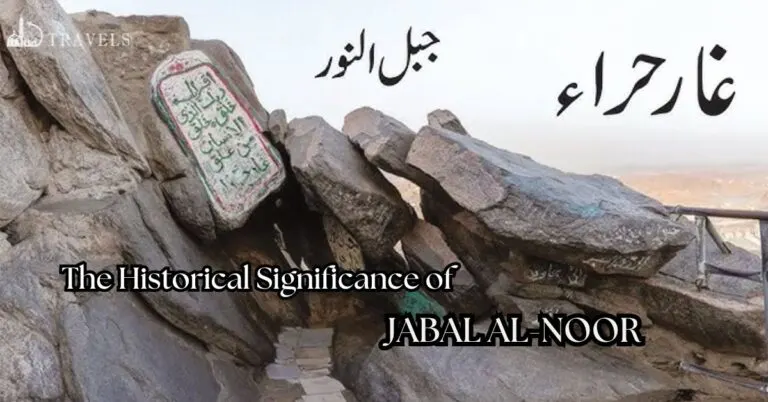
Table of Contents
It is one of the most famous historical attractions of the Holy land where pilgrims often visit. It is positioned near Haram within a few kilometers distance. These mountains are considered historically important for Muslims around the world. Jabal al-Noor is famous for its deep connection with the early days of Islam. Our beloved Prophet (PBUH) also spent a long time on this mountain as the famous cave, The cave of Hira was near the peak of it. This mountain is named after various terms like Jabal al-Quran, but is often known as Jalab al-Noor.
The Ghar-e-Hira and the Revelation
The renowned cave, Ghar-e-Hira, is often regarded as the heart of this mountain, adding to its significance and making it even more respected among the Muslim community. The cave of Hira was the location where the first revelation of the Quran was performed to Muhammad (PBUH). At the age of 40, during one of his frequent visits to the cave for solitude and reflection, the Angel Jibreel appeared to him with the holy message from the (Surah Al-Alaq, 96:1).
This cave is considered more than a historical place, it is marked as a landmark from where Islam began. Considering it just a cave won’t be appropriate as it projects the rise of religious guidance through the revelation of the significant Holy book Quran. Whenever a pilgrim performs Hajj or Umrah his first historical location to visit is Jabal Al-Noor and Ghar-e-Hira.
Significance of The Cave of Hira
The cave of Hira is known as the most realistic and spiritual cave as Muhammad (PBUH) dedicated most of his time here while he isolated himself from the people of Makkah, worshiping and spreading og Islam. It was this religious cave where Angel Gabriel appeared and asked (PBUH) to recite and read. It was the moment when the Quran was revealed to the Prophet (PBUH) when he was staying away from everyone in the honored cave.
Reference of Hadiths Related to the Revelation in the Hira
The Prophet’s Experience in the Ghar-e-Hira
It was narrated by Aisha (RA):
“(PBUH) used to go into seclusion in the cave of Hira where he used to worship (Allah alone)... suddenly the Truth descended upon him while he was in the cave of Hira.”
(Sahih al-Bukhari)
This hadith promotes the true event of revelation of the Quran, when Prophet Muahhamad (PBUH) was isolated from the world, staying in the cave, and witnessed angel Jibril (A.S) when he often retreated to the Hira to worship Allah Almighty.
The Prophet's Fear After Revelation
"... his heart was beating severely… he went to Khadijah (R.A) and said, ‘Cover me! Cover me!’”
This Hadith explains the circumstances and feeling of the Holy Prophet when he encountered the revelation with his heart beating so fast, he went to Hazarat Khadijah, where she covered him with a blanket and consoled him until he was calm.
Spiritual Visits and Reflection of Sincerity
Back in history, there were several discomforts and hardships faced by the Muslims that were put on by rivals and other clans. To get these difficulties solved, the Prophet (PBUH) often climbed the significant mountain to meditate and think peacefully about the ongoing situations including worshiping the idols placed in Islamic sites, injustice, and decay in humanity as well as morals at the time. His frequent visits and sincere consideration towards Ghar-e-Hira showed his piety for the ongoing situations in Makkah and search for the truth, even before he was chosen as a Prophet.
This reflection of the mountain's history promotes the importance of spiritual retreat and self-reflection in the Islamic tradition. Many pilgrims today climb the steep path of Jabal al-Noor to connect with this legacy of devotion and sincerity following the footsteps of the great Prophet (PBUH).
Jabal-al-Noor, A Symbol of Revelation and Light
This mountain is termed as the Mountain of Light, because of the spiritual guidance and knowledge our Prophet gathered from here during his stays. The revelation of the Quran is the great knowledge that was bestowed upon the Muslims, just like the light lightening a dark space. The power of knowledge that we got from the Quran is unmatchable and it all was possible just beauce of our Prophets' sincerity towards his people and Islam. It presents a turning point not just in the life of the Prophet (PBUH), but also for the human race, as it highlights the knowledge that would spread across the world and transforms several mindset and countless lives.
This mountain is a strong symbol of the truth, as it unveiled the revelation of Islam through the Quran and sayings.
The importance of seeking truth
The weight and responsibility of divine knowledge
The beginnings of Islamic and Quranic revelation
Revelation of Knowledge: Visiting Jabal al-Noor Today
Although visiting this valued mountain Jabal-al-Noor is not part of the Umrah or Hajj rituals, pilgrims often include visiting here because of its spiritual value and historical significance. The visit to this lighted mountain is not just a spiritual journey but also a doorway to the cave where the Prophet PBUH spent most of his time in spiritual practices. Pilgrims often climb the steep mountain, which is a difficult step that takes hours, but the experience at last is unmatchable and victorious. Visitors stand where the Prophet (PBUH) stood, gaining a deeper appreciation for the hardships he went through for his people and the greatness of the message he received.
Final Words
Jabal al-Noor holds significance as a divine light of knowledge. Its historical and religious importance continues to inspire billions of hearts and souls, making them remind the origin of Islam and the great moment when the first words of the Quran were unveiled. Pilgrims who prefer visiting here during their Umrah and Hajj journeys, often experience the essence of reflection, admiration, and a strong connection to the Holy Prophet (PBUH) and the message of Islam.